
On Tolkien’s Mithril
The Properties, Origins, and Real-World Geology of Tolkien’s True-Silver


Written by Ian Gubbenet & Nimue Avallon
Mithril is described in The Lord of the Rings with unusual specificity: a silver-white metal, lighter than iron, harder than tempered steel, mined from deep veins beneath the Misty Mountains, and permanently resistant to tarnish. In Khazad-dûm it was the source of Dwarven wealth and, ultimately, Dwarven doom. The coat given to Bilbo and later to Frodo stops an Orc-chieftain’s spear-thrust in Moria, an orc arrow, and Gríma’s knife at Bag End.
Researchers have proposed real-world analogues before, with good partial results. The problem is that every prior analysis tests mithril against one or two of its properties at a time. This essay tests all four simultaneously. When that is done, no single pure element qualifies, but that is the wrong frame. The geological mechanism Nimue proposes here identifies what mithril actually is: not a material that exceeds what nature can produce, but one that nature produced once, under specific conditions, in one place. The Carpathian parallel identified here through the NOME Timeline provides real-world support for the geological, economic, and folkloric claims the analysis makes about Moria.
What Tolkien Actually Says
Tolkien is unusually specific. Gandalf’s speech in Khazad-dûm establishes both the economic and material character of the ore:
“The wealth of Moria was not in gold and jewels, the toys of the Dwarves; nor in iron, their servant... For here alone in the world was found Moria-silver, or true-silver as some have called it: mithril is the Elvish name. The Dwarves have a name which they do not tell. Its worth was ten times that of gold, and now it is beyond price; for little is left above ground, and even the Orcs dare not delve here for it.”
And then the properties:
“Mithril! All folk desired it. It could be beaten like copper, and polished like glass; and the Dwarves could make of it a metal, light and yet harder than tempered steel. Its beauty was like to that of common silver, but the beauty of mithril did not tarnish or grow dim.” (FotR, II.4)
Mithril is not described as an alloy, and the Dwarves find it in the rock rather than making it themselves. That said, “mined in veins” does not automatically mean elemental, since natural composites exist and “metal” is not the same as “element.” What the textual presentation establishes is a material with intrinsic, stable properties that Tolkien treats as a metal species, not a recipe. The language throughout is of a singular ore-body substance, not a crafted composite, and no passage treats its properties as anything other than inherent to the material itself. That is the claim this essay works from.
Gandalf’s “here alone in the world” sits in some tension with references elsewhere in the legendarium, including material in Appendix A, that imply mithril existed or was known outside Moria. This is best read as textual variance rather than a precise geographic claim, and it does not affect the material analysis either way.
Where the Concept Came From
Tolkien never stated explicitly where mithril came from, but the evidence points to two sources.
The Norse armament tradition, notably the Hervarar saga cycle, forms part of the documented background to Tolkien’s Dwarven material culture. That tradition features impenetrable dwarven-made armor that no weapon can pierce, and the broad pattern of a coat forged in the deep places that defeats every weapon is consistent with what mithril becomes in the legendarium. The connection is one of cultural inheritance rather than direct derivation from a single passage.
The second source is linguistic. Tolkien described his creative method repeatedly: the name comes first, and the thing grows from the name. Mithril in Sindarin breaks down as mith (luminous pale grey) combined with the root -ril (brilliance or glitter), attested in Parma Eldalamberon XVII, with Tolkien’s internal etymologies occasionally shifting across compositional phases. The name means something close to “grey-brilliance,” a silver-white metal that never dims. The root -ril carries associations of concentrated light in other Tolkien formations, appearing for instance in Silmaril where it contributes the same sense of captured radiance, tying mithril conceptually to luminosity rather than mere silver coloration. Once that name existed, the material had to match it. Mithril is a philological act before it is a metallurgical one.
Gandalf’s aside that “the Dwarves have a name which they do not tell” is more significant than it first appears. The Elvish name describes surface appearance: mith-ril, grey-brilliance, what mithril looks like when held to the light. The Dwarven name would encode what the Dwarves actually needed to know: how the ore behaves under heat, how it responds to the hammer, perhaps the geological signs by which a Dwarf would recognize the right vein. The Elvish name tells you what mithril looks like, while the withheld Dwarven name likely tells you what mithril is. The Dwarves held the complete knowledge of the material and kept it private, while the Elves held only the surface description. This division maps cleanly onto the broader relationship between the two peoples throughout the legendarium.
The Four Properties
Tolkien establishes four properties, and all four have to hold simultaneously.
Appearance: silver-white, with the luster of fine silver.
Weight: light enough to wear as a coat of mail in combat without the narrative treating it as burdensome, given that Frodo runs in his.
Hardness: harder than tempered steel, stopping a spear-thrust, an arrow, and a knife.
Non-tarnishing: the beauty of mithril “did not tarnish or grow dim,” permanently, with no coating or treatment required.
The hardness claim deserves some unpacking, because “harder than tempered steel” means something specific in the text that does not map cleanly onto what metallurgists mean by hardness. In materials science, hardness is a precise measurement of how resistant a surface is to being scratched or dented, tested on scales like Rockwell and Vickers, but combat effectiveness is a different question. Real chainmail fails when rings deform under pressure, when rivets pop, when links shear apart, or when blunt force is transmitted straight through without the rings breaking at all, and a material can score lower on a hardness test and still outperform steel in every way that matters for armor. The relevant bundle of properties is yield strength plus toughness plus resistance to cutting, not hardness alone. What the text demonstrates across three incidents, the spear-thrust in Moria, the orc arrow, and Gríma’s knife, is that the coat resists penetration, resists cutting, and resists deformation, and those are three distinct challenges that mithril handles without apparent strain. When Tolkien says “harder than tempered steel,” he means better than steel in every way that armor needs to be better, and that is a coherent claim that this essay treats as one.
Testing Real Metals
Silver is the obvious starting point, since Tolkien calls mithril “true-silver” and “Moria-silver,” and the appearance is right because fine silver has a bright white luster that matches Tolkien’s description exactly. Silver fails everything else, however, tarnishing readily through exposure to hydrogen sulfide and sulfur compounds in the air, ranking among the softer metals, and making extremely poor armor. Silver satisfies property 1 and nothing more.
Platinum and palladium belong to the noble metals, a group whose resistance to tarnish and corrosion runs deep enough that ordinary conditions cannot overcome it, and that resistance is permanent, which is exactly what Tolkien describes. The problem is weight. A typical riveted steel mail shirt weighs between nine and thirteen kilograms, reflecting iron’s density of 7.8 grams per cubic centimeter, while platinum sits at 21.4 grams per cubic centimeter, nearly three times as dense. Scaling the same coat to platinum construction produces something in the range of 25 to 35 kilograms, roughly the weight of a full suit of plate armor, which makes it functionally unwearable for a hobbit-sized wearer and incompatible with Tolkien’s portrayal. The weight constraint eliminates platinum as a structural material regardless of its surface properties.
Titanium is the strongest real-world candidate, with a genuinely better strength-to-weight ratio than steel, meaning it resists forces that would deform steel while being substantially lighter. Titanium’s density is roughly 0.58 times that of steel, so the same coat scaled to titanium construction would weigh approximately five to seven kilograms, light enough for a hobbit to move freely. Titanium also develops a thin, transparent, self-healing oxide film that protects it from corrosion without maintenance, reforming if the surface is scratched or damaged. The color, however, is wrong, because even at high polish titanium reads distinctly greyer than silver. Titanium satisfies properties 2, 3, and 4, and fails on property 1.
Aluminium and magnesium come up occasionally in popular discussions, but both are lighter than titanium while also being softer and duller in appearance, failing on properties 3 and 1 simultaneously.
Testing pure elements against the four properties produces the same result every time: no single element satisfies all four simultaneously because those properties are distributed across different materials in the actual world. The conventional conclusion from that observation is that mithril must therefore exceed what nature can produce, but Nimue’s geological hypothesis, developed in the next section, identifies why that conclusion is wrong. It assumed the only candidates were pure elements or conventional alloys, and what forms under the conditions she describes is neither.
The Geology of Moria
Tolkien places mithril in specific geological conditions, occurring in mineral veins running through rock, concentrated under one particular mountain range, with the richest deposits going north toward Caradhras and descending into unknown depth.
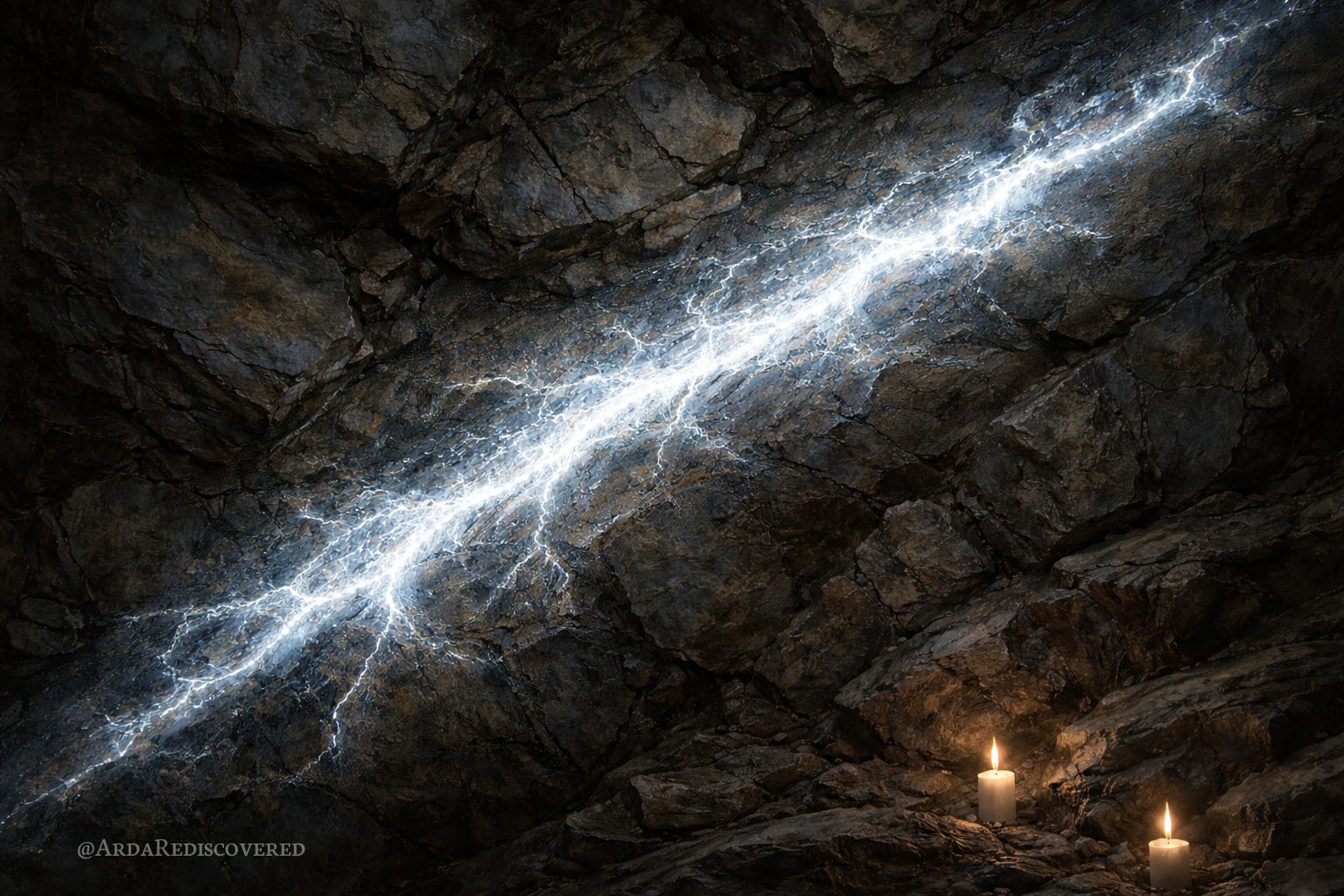
Geologist Nimue Avallon proposes that what the Dwarves mined was a genuine composite formed in place by four interacting geological factors operating simultaneously over deep time, and it is her identification of these four factors together, particularly the piezoelectric mechanism, that resolves what the material analysis alone could not.
Piezoelectric currents are generated by quartz under sustained tectonic compression, and quartz is strongly piezoelectric because pressure produces an electrical charge. A mountain range composed in part of quartz-bearing rock under prolonged tectonic stress would generate sustained low-level electrical fields moving through the rock continuously, and this is not a transient effect but one that would persist for as long as the compression continued, which in the case of a mountain range raised by the geological violence Tolkien describes in the First Age means timescales measured in millions of years.
Hydrothermal fluids carry dissolved platinum-group metals and titanium-bearing minerals in ionic form through the fracture networks, and both platinum-group metals and titanium-bearing minerals occur naturally in mantle-derived rocks brought up by tectonics, the kind of deep primordial formations associated with ancient shield geology. Superheated water moving through fractured rock under pressure dissolves minerals from the surrounding stone and carries them upward, depositing what it carries as it rises and cools.
Volcanic gases, particularly sulfur dioxide and carbon monoxide in the deep anaerobic environment below the mountain, maintain a reducing atmosphere, and this is the condition that prevents titanium oxide from forming and stabilizing as a discrete layer. In an oxygen-rich environment titanium develops a stable oxide skin that keeps it chemically isolated from surrounding minerals, but in a reducing atmosphere that skin does not form, leaving the titanium ions available for bonding with whatever else is present in the same depositional space.
Temperature gradients drive directional ion migration through the fracture system, governing where and how minerals concentrate along the vein walls.
Under those four conditions simultaneously, deposition is not sequential, and titanium is not deposited first with platinum layered over it afterward. Both are deposited simultaneously into the same fracture space, with the sustained electrical field from the piezoelectric effect governing how the ions orient and bond at a crystalline level as they come out of solution together. The result is not a coating but a co-formed material with platinum integrated into the titanium crystal structure from the moment of formation.
This resolves the fretting wear problem directly, because fretting wear occurs at the interface between two dissimilar materials, and in a co-formed material where the two components have bonded at a crystalline level during simultaneous deposition there is no interface in that sense and no boundary layer to abrade. It also resolves the galvanic corrosion problem, because galvanic corrosion requires an electrolytic medium bridging two metals with different electrochemical potentials at a surface interface, and in a true co-formed composite where platinum is integrated into the titanium structure rather than coating it that electrochemical geometry does not exist.
A note on the speculative status of Nimue’s mechanism is warranted. No known terrestrial deposit has been documented to produce a true platinum-titanium co-formed composite through this process, and what she proposes is a geological possibility rather than a documented occurrence: a mechanism that the physics and chemistry do not forbid, operating under conditions the legendarium’s geology provides, producing a result that would explain what the texts describe. It is offered as a proposed mechanism, not an established one.
One further implication deserves attention. Titanium in nature occurs primarily as minerals, ilmenite and rutile being the most common, rather than as a free metal ready to be worked, and reducing them to usable metal would require capabilities beyond anything in the human metallurgical record. The legendarium consistently presents Dwarven craft as operating at a level that human metallurgy never reached, and the geology Nimue describes demands exactly that. The Dwarven name for mithril, the one they did not share, almost certainly encoded the knowledge of how to do it.
The unusual richness of the Moria deposit specifically would require the Misty Mountains to have had the right deep geological history, which in legendarium terms corresponds to their violent origins in the First Age, raised by Melkor to obstruct the march of Oromë, and the legendarium geology and Nimue’s proposed real geology are compatible rather than competing accounts.
The economic structure that follows from this geology is one of the more underappreciated elements of Tolkien’s construction. Single-resource economies intensify risk as extraction becomes harder, because the more difficult and costly it becomes to obtain the resource, the more the civilization has already committed to obtaining it and the less capacity it retains to do anything else. Khazad-dûm was built on exactly this structure, and as mithril “became yearly ever harder to win,” the Dwarves did not stop because they could not afford to. The Balrog was not the cause of Moria’s fall but the end of a process that had been running for centuries.
The Carpathian Parallel
The NOME Timeline, developed in my Arda Rediscovered series, treats Tolkien’s Ages as literal prehistory. Working from Tolkien’s own note in The Nature of Middle-earth that 1960 CE equals the 1960th year of the Seventh Age, the end of the Third Age falls around 4,001 BCE and Moria’s peak production falls in the Second Age, roughly the tenth to eighth millennium BCE. In actual human history that period is the Pre-Pottery Neolithic, before copper-working and millennia before bronze, which means that by the time real metallurgists were working out tin-bronze, the Moria deposit was already sealed and the craft was gone. This framework operates as an internal chronological model, not as a claim about Tolkien’s intent.
Within that framework, my research into Central European mining history identifies the Carpathians as a real-world parallel for each of the three claims this essay makes about Moria: the geological setting, the single-resource economy, and the folklore of underground craft peoples.
On geology, the Slovak Ore Mountains in central Slovakia sit on top of an ancient volcanic caldera, and the eruptions forced high concentrations of precious metals into veins through the surrounding rock, a mantle-source concentration consistent with the mechanism Nimue proposes. The hill above the oldest workings was called Glanzenberg by the German miners who settled the region, meaning the Shining Mountain. The city of Banská Štiavnica that grew above those mines became a major Central European mining city at its height, and its founding legend, preserved in early modern tradition and likely reaching back further, tells of a shepherd who noticed two lizards dusted with silver and gold, followed them to a rock, rolled it away, and was blinded by glittering ore.
On economy, the Banská Štiavnica mines produced silver and gold that financed Vienna and Budapest for centuries, and when the ore ran out the city declined sharply and the mines closed in the 1990s. Khazad-dûm’s trajectory is compressed and catastrophic where Štiavnica’s was gradual, but the underlying structure is identical: wealth from a single ore body, increasing extraction difficulty over time, and eventual collapse when the resource failed.
On folklore, the mining towns of the Carpathians preserved a tradition of underground craft spirits rooted in German mining folklore. The Bergmännchen, small figures in miners’ clothes roughly three feet tall, appeared in the Štiavnica mines as signs of rich finds, and folklore told of conflicts between different peoples of the deep, small mountain devils against small mountain men, with ore controlled by beings who could give or withhold it. Within the NOME model, the dvergar of Norse mythology, the Bergmännchen of the Slovak mines, and the Dwarves of Khazad-dûm can be read as three expressions of cultural memory reaching back to the same source rather than independent inventions of the same archetype.
What Mithril Is
Mithril is a co-formed platinum-titanium composite produced by four geological conditions coinciding over deep time: piezoelectric currents generated by quartz under sustained tectonic compression, hydrothermal fluids carrying platinum-group and titanium-bearing ions through the fracture network simultaneously, a reducing atmosphere maintained by volcanic gases preventing titanium oxide from forming and isolating the titanium chemically, and temperature gradients driving directional ion migration along the vein walls. Under those conditions, both metals are deposited into the same fracture space at the same time, with the piezoelectric field governing how the ions orient and bond at a crystalline level as they come out of solution together, and the result is not two materials in contact but one material.
That material satisfies all four properties Tolkien establishes. The platinum integrated into the crystal structure produces the silver-white optical appearance that titanium alone cannot achieve. The titanium crystal structure provides the strength-to-weight ratio that makes the coat light enough to wear freely and hard enough to stop a spear-thrust, an arrow, and a knife. The noble metal component, bonded into the structure rather than sitting on top of it, delivers permanent tarnish resistance with no interface to abrade and no electrochemical geometry to corrode. The four properties are not distributed across different materials requiring two metals to do the work of one: they are the properties of one material, formed under one set of conditions, in one deposit.
Those conditions required the particular tectonic history of the Misty Mountains, a long-lived hydrothermal system drawing on the right mantle material, and timescales that no human civilization has observed directly. When the deposit was exhausted and the mountain sealed, the material ceased to be accessible, and whether veins of it persist somewhere in the deep rock is a question the geological record cannot answer.
The craft that knew how to work it is gone, and the people who held the complete knowledge of its properties kept that knowledge in a name they never shared. What the Earth made once, under conditions that may not exist anywhere today, it is unlikely to make again.
Sources
Primary texts: The Lord of the Rings, 50th Anniversary Edition (HarperCollins, 2004). The Hobbit, third revised edition (1966). Unfinished Tales, ed. Christopher Tolkien (1980). The Silmarillion (1977). The Nature of Middle-earth, ed. Carl F. Hostetter (2021).
Linguistic: Parma Eldalamberon XVII, ed. Christopher Gilson (2007). Paul Strack, Eldamo: An Elvish Lexicon (eldamo.org).
Secondary scholarship: Hammond and Scull, The Lord of the Rings: A Reader’s Companion (2005). Tom Shippey, The Road to Middle-earth (1982, revised 2003). Roland Lehoucq, Loïc Mangin, and Jean-Sébastien Steyer, eds., The Science of Middle-earth, trans. Tina Kover (Pegasus Books, 2021), including material on mithril by James Owen.
Carpathian material: Encyclopaedia Britannica, “Banská Štiavnica”; UNESCO World Heritage List, “Historic Town of Banská Štiavnica and the Technical Monuments in its Vicinity” (1993).
Correspondence: Nimue Avallon (geological consultation, February 2026).
NOME Timeline: Ian Gubbenet, “Dating Middle-earth: The NOME Timeline,” Arda Rediscovered (ardarediscovered.substack.com).
 | A guest post by
|
I thought I had reached the upper crust of nerd-hood but lo, once more I am reminded that there are levels to this game.